|
|
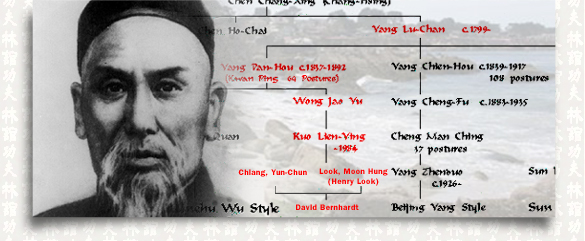
Lineage
Yang, Lu-Chan (1799-1872) also know as Yang Fu Kui
was born in Nan Guan of Yong Nian County in Hebei province.
He was from a farming family and worked in the local grocery
store during his break after harvesting. In his youth he had
learned Shaolin Kung Fu and was always interested in martial
arts and when an opportunity arose for him to learn martial
art from a master in the Chen Jia Gou village call Chen Chang
Xing, (who had learned Tai Chi from Jiang Fa) he proceeded
to seek the master out. After years of training, Yang Lu Chan
was accepted as a disciple and given the full transmission
of the system. Yang Lu Chan spent 18 years to finish his study
of this soft style of martial art from Chen Chang Xing.
After leaving the Chen Jia Gou village, Yang Lu Chan went
to Beijing and began to perfect his Tai Chi Chuan skills.
After years of continuous training and self-research, he achieved
a high level of martial art skill that he defeated all challenges
from masters of other kung fu styles through out China and
be known as Yang Wu Di (Yang the Invincible).
Yang Lu Chan had two sons, Pan Hou and Jian Hou. Eventually
his sons helped him to train his grandson Yang Cheng Fu to
be the greatest Tai Chi Chuan teacher in China.
-------------------------------------------------------------------------------------------------------
Yang, Pan-Hou (1834-1902) was the second son of Yang,
Lu-chan. The first son died young. Pan-hou was small of stature,
agile and quick tempered by nature. Both he and his younger
brother, Yang, Chien-hou, were forced to train in Tai Chi
Chuan by their father.
They were not very happy about the hard work and Chien-hou
is said to have run away at one point. It is also said that
both brothers thought of joining a Buddhist Monastery to get
away from home. The training was hard and constant. Yang,
Lu-chan was known to have been a demanding father and teacher.
Of the two brothers, Pan-hou's Tai Chi was said to have been
the best. As a teacher he was not very popular with his students.
He demanded a great deal from them and was quite violent in
his training methods. Very few students were able to stick
with him. He met Wang, Jiao-yu while training guards and courtiers
of the Imperial court in Beijing.
-------------------------------------------------------------------------------------------------------
(Image Not Available)
Wang, Jiao-Yu (1836-1939) was a stable hand and carriage
driver for one of the Manchu princes. It was a position held
by his father. Pan-hou met and took a liking to Wang Jiao-yu.
This was the beginning of their relationship. Pan-hou taught
Jiao yu the Tai Chi we now call Yang Kuang P'ing.
As we already know, the set taught to Wang, Jiao-yu was different
from the one taught in the Imperial court. Training was conducted
in secret. Secrecy was not unusual in any of the boxing arts
during this time. Wang Jiao-yu did not reveal his art until
the turn of the century. He lived at the Lu-Tsu temple in
the Ho-Ping-Men (Door Of Peace) sector of Beijing. It is said
that he accepted only five students. Kuo Lien-ying was among
the five.
-------------------------------------------------------------------------------------------------------
Kuo, Lien-Ying (1897-1984) had an interesting and
long life. He was northern Chinese and said to have grown
up in Hu Ho Hao Te, Inner Mongolia. He took up Shaolin boxing
and the classical fighting weapons as a youth and was a bodyguard
in his early years. While in his 20s, he heard of Wang, Jiao-yu
in Beijing and sought him out. He was refused entrance as
a student for 6 months and accepted after repeatedly asking
to be taught. Many years of intense practice are required
to master an internal martial art and teachers tested a students'
resolve to learn before being accepted.
It was from Wang, Jiao-yu that Kuo, Lien-ying learned the
art and method of Tai Chi chuan. He went on to master Ba-gua
and Shing-yi and became one of China's most noted practitioners
of the internal arts. He was, also, a congressman in the National
Assembly of China during the Republic of China. He was given
a state funeral by the Peoples Republic of China when he died
in 1984. He had a number of Chinese and non-Chinese students.
Chiang Yun-Chun (below) was Kuo's student in Taiwan during
the 50s and early 60s and both Chiang, Yun-Chun and Look,
Moon Hung studied with Kuo in the U.S.
-------------------------------------------------------------------------------------------------------
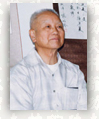
Chiang, Yun-Chun teaches and lives in El Cerrito,
California. He is a noted Painter, Internal Martial Artist,
Calligrapher, and Oriental Medical Doctor. He is the former
Chairman of the California State Board of Examiners of Oriental
Medicine. He is Master of the Wen Wu school of traditional
Chinese arts in El Cerrito. Master Chiang was a student of
Kuo Lien Ying and Wang Ji-chen, both of whom were students
of Wang Jiao-yu.
Master Chiang is considered a master of the five excellencies
of Chinese culture. He has mastered internal healing and boxing
arts. They are: Tai Chi Chuan, Ba-gua, Shing-yi, Shaolin (and
it's off shoot styles), Fukien White (RYU HE CHUAN) Crane,
and various Chi-gung styles, Chinese classical weapons, strategy,
and philosophy. Additionally, he has mastered and teaches
traditional Chinese painting, calligraphy, and seal carving.
Some of his paintings and calligraphy reside in museums in
the West and East. His paintings were presented to U.S. Presidents
Eisenhower and Carter during their administrations. He recently
was given a retrospective art showing at the Chiang Kai-shek
memorial hall in Taipei, R.O.C..
As a result of the revolution in the early 1900s, Sun Yat-sin's
resolve to create an open and healthy China inspired the masters
of various arts to open their studies to the general public.
Yang, Chen-fu taught the Beijing style of Yang Tai Chi at
the Republic's school for martial arts. His intention was
to help Chinese people gain strength and good health from
the practice. Sun's principle of openness was also practiced
by Master Kuo. Master Chiang follows in this same tradition.
War disrupted the development of the Republic and most students
of Chinese history are familiar with the Communist's and the
Kuomintong's prolonged war during the Japanese occupation
of China. Due to the Communist take over in China, Master
Kuo and Master Chiang made their way to Taiwan. Master Kuo
went to San Francisco in the middle 1960s followed by Master
Chiang in the late 60s. Master Chiang is from Da Ming city
in Heipei Province, China.
-------------------------------------------------------------------------------------------------------
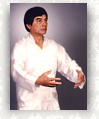
Look, Moon Hung (Henry Look) is one of the few true
lineage holders of Chinese internal martial arts in America.
He has studied Taiji, Xingyi, Bagua and Qigong for over 30
years. Since 1970, he has had the good fortune to train with
Grandmaster Kuo Lien Ying, Grandmaster Han Hsing-Yuen and
Professor and Madame Yu Peng-Shi, outstanding masters all
who trace their lineage directly to the great Xingyi master
Kuo Yun Shen, reputed to be the greatest xingyi fighter of
his generation.
Master Look is the founder and director of TIMA (Tri Internal
Martial Arts), as well as
the founder and honorary chairman of the Guang Ping Yang Tai
Chi Association. He
also serves as the official advisor to the U.S. Chinese Kuoshu
Federation, Director of Xingyiquan, Hall of Fame committee
member and national martial arts judge. In the past few years,
Grandmaster Look has been named Inside Kungfu Magazine’s
“1997 Hall of Fame Instructor Of The Year,” and
was included in their “100 Best, Greatest and Most Influenctial
Martial Artists of the Twentieth Century.” He also was
named Inside Kungfu’s “2004 Man of The Year.”
He was furthermore inducted into the USA Wushu Kung Fu Federation’s
Hall of Fame, winning their Lifetime Achievement Award.
-------------------------------------------------------------------------------------------------------
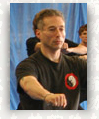
Bo Dah-Wai (David Bernhardt) has been training in
the Martial Arts for over 40 years. He holds Instructor Certification
from the Guang Ping Yang Tai Chi Association and from Grand
Master Look, Moon Hung. Sifu Bo was given the honor of "Living Legend" and inducted into the Martial arts Masters Hall of Fame in Anaheim, CA. He is a Gold Medal Champion in Guang
Ping Tai Chi from the U.S. Chinese Koushu Federation, at San
Francisco’s International Martial Arts Competition and is certified as an Internal Martial Arts judge by Grand
Master Look, Moon Hung.
A teacher since 1976, Master Bernhardt has taught on both
coasts of the United States as well as internationally. He
has also achieved black belts in six styles. His accomplishments
include 3 first degree black belts, a 3rd degree black belt
and two 4th degree black belts. His studies have included Wing
Chun, Jeet Kune do, Tae Kwon Do, Ying Jow Pai, Kune Mu Kwon,
5 Animal Gung Fu, Choi Lai Fut, Kajukenbo, Kenpo, Arnis/Kali, Iaido, Hsing-I,
Guang Ping Tai Chi and Guang Ping Tai Chi weapons, Chi Gung
and Zazen. Master Bernhardt has been fortunate to have both
Grand Master Chiang, Yun-Chun and Grand Master Look, Moon
Hung as his teachers.
A heartfelt thanks is also
given to Claudio Navarro, Eric Estrada, Richard Molina and
Eddie Peterson, all extraordinary martial artists for their
influences in the early days, as well as an extra special
thank you to Eddie Peterson for his mentoring in the ways
of street awareness, street fighting technique and deep friendship.
Additional influential
and notable teachers:
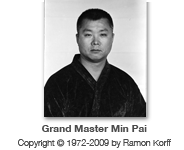
Grand Master Min Q Pai was born in Korea in the 1930s and moved to the United States
as a young man in the 1950s. He studied mathematics in college
and worked on a dairy farm. He began teaching martial arts
in New York City in the early 1960s. Master Pai received his
Black Belt at 14 years of age. He called his school Yun Mu
Kwan Karate, which he often translated as “constantly
honing yourself.”
The 1970s were a transformative decade for Master Pai, as
he met both Eido Roshi and Chang Man Ching. Studying with
absolute intensity both Zen Meditation and Tai Chi Chuan,
Master Pai changed the Karate school. Students now were expected
to sit, do Zazen, and all Black Belts were immediately taught
Tai Chi. The moves being taught in Karate class, always evolving
as Master Pai learned or perceived a better way, now changed
dramatically as Kung Fu forms and exercises replaced many
of the Karate and Tai Kwan Do ways of moving. In December
of 1987 Master Pai introduced an entirely new form he had
created, Nabi Su, and eventually changed the name of the style
and of the school to Nabi Su. Nabi means Butterfly in Korean.
In 1992 Carolyn Campora became the head of Nabi Su, continuing
the tradition of Master Pai’s teaching of the martial
arts in N.Y. City
In 1979 Master Pai purchased property in Pound Ridge, NY which
was to become Wellspring Zendo. This land afforded an opportunity
for the students to build their spirit/bodies in a new way
through work/practice, moving through the beautiful country
setting practicing posture and no-thought while lifting, carrying,
chopping, planting, breathing. Even before the Monastery was
built, sitting practice took place in the open air, formal
traditions enacted in a pioneer setting.
Master Pai has left an indelible mark on the world, profoundly
affecting my life and the lives of many directly, as well
as indirectly through all those whose lives his students touch.
We are grateful, Sir, every day, for your teaching.
The information above is courtesy of Master Carolyn Campora.
Nabi Su is a registered servicemark of Carolyn Campora. Nabi Su Martial Arts & Wellness Center
The photograph of Master Min Q Pai is Copyright © 1972-2022
by Ramon Korff.
Master Mikio Nishiuchi lived in Okinawa and learned kobudo directly from the late Hanshi Shinpo Matayoshi, Juudan, Zen Okinawa Kobudo Renmei and from Kaicho Takashi Kinjo, kyuudan, Kokusai Okinawa Budo Renmei, both of Naha, Okinawa. Shihan Nishiuchi is a nanadan in Pang Gai Noon Ryu Karate-Do (Uechi Ryu) and obtained his degree from Kaicho Takashi Kinjo. Shihan Nishiuchi has been training for over 50 years. He was born and lived in Kochi City, Shikoku Island, Japan and came to the United States when he was 30 years old. Shihan Nishiuchi also practices Iaido, classical Japanese swordsmanship, and holds a certified Chuudan degree in Musojikiden Hasegawa Eishin Ryu Iaiheiho. He gives seminars world-wide He officially formed International
Okinawa Kobudo Association (IOKA) in 1990.
Hanshi Dave Kovar, the head instructor of
Kovar's Karate Center, Inc., has been teaching karate since
he was 15 years old. He is a 8th degree Black Belt and has
the rank of Black Belt in 8 different styles. With over 2,500
active students, Kovar's is not just one of the oldest and
most established Martial Arts schools, but is ranked as one
of the top schools in the nation. Hanshi Dave Kovar, the founder of Kovar Systems and Kovar’s Satori Academies, started his martial arts journey in 1972 as a teenager, following in the footsteps of his older brother, Tim. He began studying Kenpo Karate, training under Hanshi Bruce Juchnik and immediately fell in love with the martial arts. As he recalls, he was immediately hooked and still remembers the immediate confidence boost he felt after learning his first self-defense technique. Just 2 years later, at the ripe old age of 15, he began teaching. His martial arts journey was just beginning, but his student mindset would stay with him for the rest of his life. He has embraced the best of what all martial arts have to offer, and shortly after starting his training, he began seeking out new styles, disciplines, and training partners to compliment his growth as a martial artist. In 1974, Kovar started Japanese Jujitsu under Bob McKean. In 1975, he began Serrada Escrima with the Angel Cabelas Organization. He earned his first black belt - his 1st degree in Kenpo Karate - in May, 1977. He would come to earn black belts in 9 other styles over his training career, while continuing to advance in his love of Kenpo.
Professer Barbara Bones, Professor Coleen Gragen, Sifu Stacy
Jolles, Master Leung Shum, Grand Master Duk Sung Son, Master
Eddie Chong.
|
|